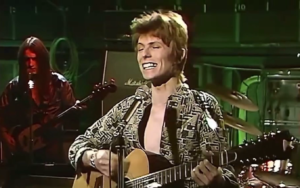
Among the stranger moments in pop culture history, few feel as unlikely—or as enduring—as the 1977 holiday duet between David Bowie and Bing Crosby. One was a restless shape-shifter in the middle of his most adventurous decade. The other was the voice most Americans associated with Christmas itself. On paper, the pairing made little sense.
By the time they met, Bowie had already lived several musical lives, while Crosby was decades removed from the era that made him famous, thanks largely to “White Christmas.” Their collaboration happened quietly on a TV soundstage, not in a studio built for experimentation. Yet that contrast is part of what still draws people back to the performance.
Years later, the moment keeps resurfacing, even being playfully referenced on Saturday Night Live in a 2025 holiday sketch. The joke worked because the original pairing already felt surreal. What the parody skipped, though, was the genuine warmth that emerged when these two very different artists finally sang together.
How the David Bowie and Bing Crosby Duet Came to Be
The collaboration was born more out of timing than planning. Crosby was preparing Bing Crosby’s Merrie Olde Christmas, while Bowie was promoting Heroes, released just weeks earlier. Appearing on the special gave Bowie visibility in the U.S. at a moment when his music was pushing into colder, more experimental territory.
There were immediate cultural hurdles. Crosby’s children later recalled Bowie arriving in full glam regalia, complete with bright red hair and makeup that clashed with the show’s old-fashioned tone. Producers reportedly asked Bowie to tone it down, and for a moment, the entire appearance seemed at risk.
The musical compromise came next. Bowie disliked “Little Drummer Boy” and asked to add a new counter-melody. That request led to “Peace on Earth,” written specifically for him. The decision shifted the song from a straightforward carol into a conversation between generations, and it gave the performance its haunting balance.
When the Cameras Rolled and the Mood Changed
The televised setup was awkward by design. Bowie appears as a visiting guest at a stately English home where Crosby is staying, and the two casually discover they are both musicians. It’s the kind of scripted politeness typical of variety television in the 1970s, and it doesn’t fully hide the strangeness of the pairing.
Once they sat at the piano, though, something shifted. Crosby’s daughter later described Bowie as visibly nervous at first, unsure how he fit into this world. Crosby, for his part, quickly recognized Bowie’s musicianship, not his image or reputation.
As the harmonies settled in, both singers relaxed. Crosby’s steady warmth anchored the performance, while Bowie’s restrained delivery added an unexpected sense of fragility. The result felt sincere rather than ironic, which is why the duet still works decades later, even for listeners who weren’t alive when it first aired.
A Lasting Moment Marked by Tragedy
Not long after the taping, the story took on a heavier weight. Crosby died of a heart attack in October 1977, just weeks after filming the special. When Bing Crosby’s Merrie Olde Christmas aired that November, the duet had already become a farewell.
Over the years, Bowie gave mixed explanations for why he agreed to the performance. Sometimes he framed it as a favor to his mother, sometimes as a simple professional obligation. Those shifting accounts likely reflected Bowie’s own changing perspective rather than any single truth.
What remains constant is the recording itself. Released as a single in 1982, “Peace on Earth/Little Drummer Boy” went on to become one of the best-selling singles in Bowie’s catalog. Long after the context faded, the performance endured—an unlikely holiday moment that turned out to be timeless.