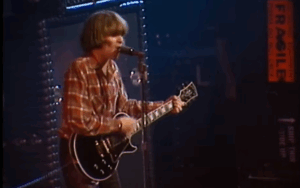
By early 1969, Creedence Clearwater Revival were no longer scraping for attention. “Proud Mary” had pushed them out of one-hit-wonder territory, but success brought pressure instead of relief. The band suddenly found itself racing against radio schedules, expectations, and a music industry that demanded constant output.
At the center of it all was John Fogerty, who felt the momentum could vanish just as quickly as it arrived. While congratulations were still fresh, he was already worried about what came next. Writing another single wasn’t optional—it was survival.
That tension seeped directly into what would become “Bad Moon Rising.” Though upbeat and deceptively catchy, the song carried a sense of unease that mirrored the uncertainty Fogerty felt personally and the instability unfolding across America at the end of the 1960s.
From a Phrase to a Premonition
The phrase “bad moon rising” didn’t arrive with a clear meaning. Fogerty had written it down years earlier in a notebook filled with potential song titles. He liked the way the words sounded long before he understood what they might suggest.
As the chords and melody took shape, another image surfaced—one drawn from The Devil and Daniel Webster. The film’s stark black-and-white visuals, especially a scene involving a violent storm, left a lasting impression on him. Objects flying, homes collapsing, nature turning hostile—it all stuck.
Those images gave the song its backbone. The looming disaster in the lyrics wasn’t about literal weather. It was about an approaching reckoning, something unavoidable and destructive, hinted at rather than spelled out.
A Metaphor for a Country in Turmoil
Although Fogerty never claimed the world was ending, the song reflected the emotional climate of the time. America was reeling from assassinations, protests, and deep social fractures. The sense that something was wrong—fundamentally wrong—was everywhere.
“Bad Moon Rising” captured that feeling without naming names or events. Lines about earthquakes, storms, and destruction acted as metaphors for political violence and cultural instability. Listeners didn’t need explanations; the mood was already familiar.
That universality helped the song resonate. It spoke to anxiety rather than ideology, allowing people from different backgrounds to hear their own fears reflected in its bright, almost cheerful delivery.
Doubt, Rehearsals, and a Perfect Session
Ironically, Fogerty wasn’t convinced the song was strong enough. Compared to “Proud Mary,” it felt rougher and more straightforward. He worried it lacked the depth and tradition he admired in earlier American music.
The rest of the band disagreed. Tom Fogerty, Stu Cook, and Doug Clifford immediately heard its potential. Rehearsals in Clifford’s backyard shed were focused and energetic, with the group fully aligned on the song’s direction.
When they entered the studio, everything clicked. Fogerty later described the session as unusually smooth, a rare moment when creativity and chemistry aligned. Despite later tensions within the band, this period was marked by cooperation and optimism.
Success, Fractures, and an Unavoidable Legacy
The song’s impact was immediate. It topped charts in the UK, reached No. 2 in the US, and propelled Green River into a defining release for the band. “Bad Moon Rising” became inseparable from Creedence’s identity.
But success also magnified existing cracks. As the band’s reputation grew, so did disagreements over leadership and creative control. Fogerty later reflected that fame can convince people they’re infallible—a dangerous assumption that contributed to the group’s eventual breakup.
The song’s widespread use added another layer of frustration. Without control over licensing, Fogerty watched it appear in countless films and commercials, some better than others. While he appreciated thoughtful placements like An American Werewolf in London, many uses felt careless. Still, decades later, the song endures—timeless, adaptable, and still powerful enough to invite both serious reflection and the occasional joke about “the bathroom on the right.”